
Most cross-border delays between Singapore and Malaysia are avoidable, and the cause is usually something that was missing or wrong before the parcel left your hands. Paperwork, packing, addresses and timing account for most of it.
Here are the most common causes and what you can do about each one.
The most common causes of delay
| Cause | What happens | How to avoid it |
|---|---|---|
| Incomplete or incorrect documents | Shipment is held while details are corrected | Check descriptions, quantities and values before you hand over; keep documents consistent |
| Restricted or prohibited items | Goods are held, returned or refused | Confirm what you are sending is allowed before you book |
| Weak or wrong packaging | Damage, repacking, or a failed handover | Use sturdy cartons, proper cushioning and clear labels |
| Wrong or incomplete address | Delivery attempt fails or is rerouted | Include unit number, postcode, a contact name and a working phone number |
| Missed cut-off time | Parcel moves on the next day's run | Book by Packargo's 4pm cut-off for next-day collection |
| Peak-season volume | Longer queues and handling times | Ship earlier than you think you need to |
| Border congestion | Longer crossing times at busy periods | Plan for extra time around weekends, public holidays and school holidays |
| Recipient not available | Redelivery needed | Give a reachable contact and tell your customer to expect it |
Our cut-off: book by 4pm to have your parcel collected the next day.
1. Get the paperwork right
Accurate documents are the single biggest way to avoid delays. Describe goods clearly rather than vaguely, make sure quantities and values match your invoice, and keep your details consistent across every document.
If you are unsure what a shipment needs, ask before you ship. A short question beforehand is much cheaper than a held parcel.
2. Know what you can and cannot send
Some goods are restricted or prohibited between Singapore and Malaysia, and others need special handling. Check before you book, especially for food, health products, electronics with batteries and anything temperature-sensitive.
For goods that need to stay cold, use a provider with proper cold storage rather than improvising.
3. Pack for the journey
Cross-border parcels are handled more often than local ones. Pack as if the box will be stacked, moved and dropped once or twice.
- Use a strong carton, not a reused one with weak corners
- Fill empty space so items cannot move
- Seal all edges and put the label on the largest flat surface
- Keep a copy of the label details inside the box
4. Give a complete delivery address
A parcel can be perfectly on time and still fail at the door. Always include the full address with unit number and postcode, plus a name and a phone number someone will answer.
5. Plan around peak periods
Volumes jump around 11.11, year-end and Chinese New Year, and crossings get busier around public holidays and weekends. Book earlier in these windows and tell your customers to expect a little more time.
6. Track it and stay informed
When you can see where a shipment is, you can fix problems early instead of finding out days later. With thePackargo customer portal, you can track shipments in real time and see your orders in one place, so a delay does not become a surprise.
Quick pre-shipment checklist
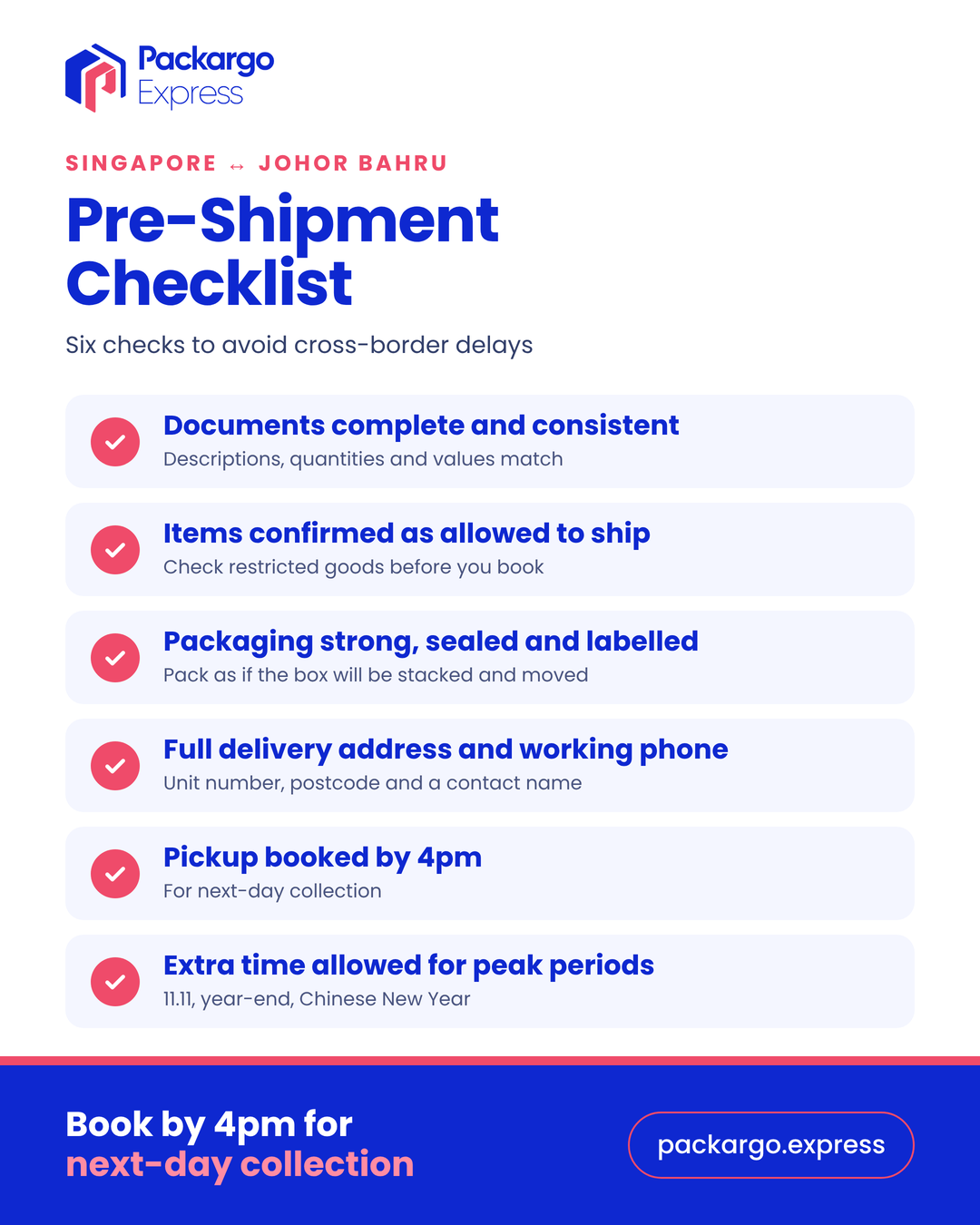
- Documents complete and consistent
- Items confirmed as allowed to ship
- Packaging strong, sealed and labelled
- Full delivery address and working phone number
- Pickup booked by 4pm for next-day collection
- Extra time allowed for peak periods
Ship with fewer surprises
Packargo Express runs door-to-door delivery between Singapore and Johor Bahru and can help you check what you are sending before it goes.